|
|
|
|
BC Purple Martin Stewardship and Recovery Program
NEW 2013! - Status Report on the Western Purple Martin in BC - see Recent Publications section below for citation Purple
Martins
are the
largest swallow in North America. The western subspecies
(Progne subis
arboricola), which occurs exclusively west of the Rocky Mountains from sw.
BC to s. California (and is separate and genetically distinct from the eastern
subspecies, P. s. subis), is Blue-listed in British
Columbia and recovering from a severe population decline in the mid-late 1900s. Historically,
Western P As other suitable habitat was lost, martins shifted to nesting in woodpecker cavities in abundant old and decaying untreated wooden pilings remaining from early industrial development around the Strait of Georgia (as well as in Puget Sound, WA, and along the lower Columbia River), and as these old pilings fell or were replaced with creosote-treated pilings (and later steel and concrete pilings), in which woodpeckers cannot excavate nest cavities, their numbers steadily declined due to the slowly declining supply of usable nest cavity sites. By the early 1980s, when old untreated pilings were almost entirely gone, the BC population of Western Purple Martins was reduced to less than 10 known breeding pairs.
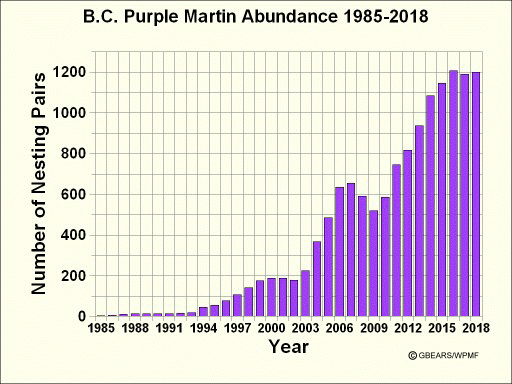
Since then, the British Columbia population of Purple Martins has rebounded to over 200 pairs by 2002, 650 pairs by 2007, 800 pairs by 2012 and 1,200 pairs by 2016-2018. This is due to the volunteer-based nest box program begun in the Georgia Basin area in 1986, as well as a similar program begun a decade earlier (1975) by conservation volunteers in Puget Sound, Washington. This growth has
not been continuous... After nearly two decades of gradual population increase
since nest boxes were provided on marine pilings, the BC population increased dramatically between 2003 and 2006,
due mainly to
After stalling for several years at 500-650 pairs (2006-10) due to low fledgling production and yearling (subadult) recruitment as a result of 4-5 nesting seasons with long cool wet periods that limited food availability and reduced nestling survival, the BC population again began to increase annually, reaching our initial interim target of 800 pairs in 2012 and 1,200 pairs in 2016, where growth has again stalled temporarily due to several years with cool wet periods in May-June, causing substantial (to 40-50%) nestling losses and low reproductive success, fledging production and resulting yearling recruitment. Since 2002, GBEARS has provided overall co-coordination and
scientific direction, monitoring and management of the BC Purple Martin Stewardship and Recovery Program. As part of this
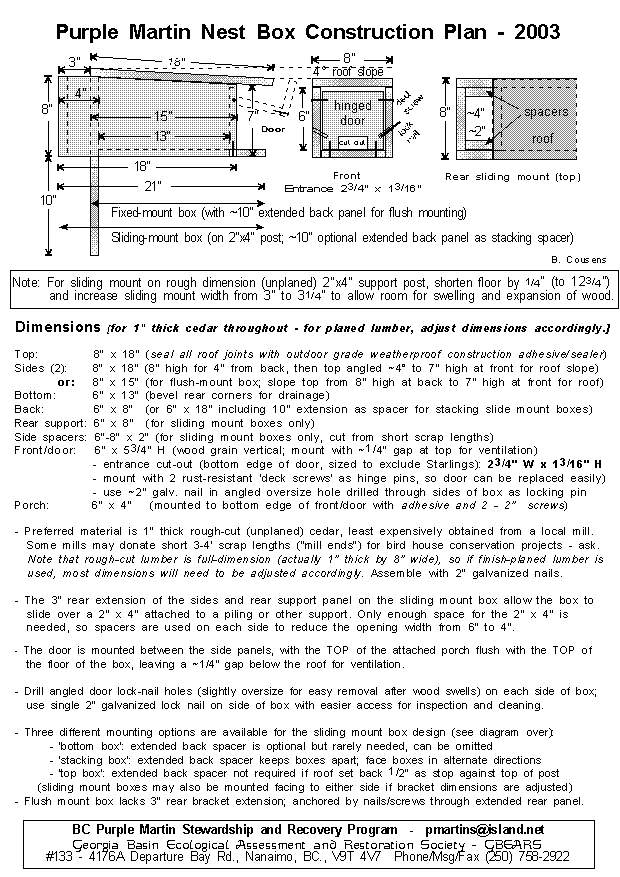
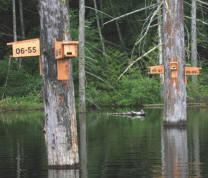
program, nest boxes are put up at potential new colony sites as well as existing ones. Each box is numbered with a unique
number that includes the year of installation. Abundance, nesting success and production at each colony site are monitored and
recorded.
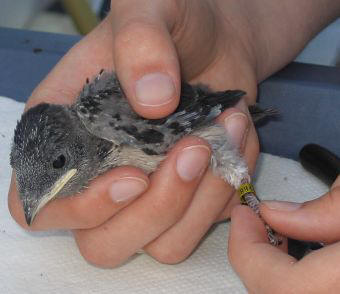
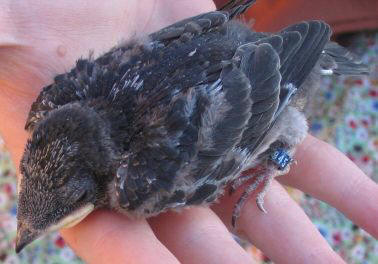
Also, Western Purple Martin nestlings from each colony were banded
In 2007 a 10-year old adult male banded in 1997 and a 9-year old adult female banded in 1998 were both identified from their band numbers and nested successfully. The female returned and nested successfully again in 2008 as a 10-year old bird. This female and a second previously unseen female returned and nested as 11-year old birds in 2009, but neither nest was successful and neither of these birds has been seen again since. These are believed to be western longevity records to date for males and females in the wild. Most martins that survive their first winter live only 2-3 years and relatively few (<10%) exceed 5 years of age. In addition, this long term banding study provides valuable information on the population dynamics and variable age composition of the BC population, which is important for understanding changes in the rate of growth or decline of the population due to variations in nesting success, fledgling production and recruitment of new subadult birds, and thus the progress and overall success of the recovery program. (Some of these results may be applicable generally to other equally weather-dependent but less closely monitored swallow populations as well.) This long-term population dynamics and age composition study is unique for Purple Martins in Canada and for Western Purple Martins in western North America, and has been supported in part by the Canadian Wildlife Service, The Baillie Fund of Bird Studies Canada, The Canadian Wildlife Foundation and Timber West..
In 2005 and 2006 a survey of remaining historic and potential
new freshwater nesting sites was conducted in preparation for re-introducing
Western Purple Martins into naturally occurring nesting cavity situations in the wild.
In general, suitable freshwater sites with snags for mounting a few "starter"
nest boxes and containing natural cavities for new colonies to expand into
as they grow were scarce, particularly on south Vancouver Is. and in the Lower
Mainland. Many historic freshwater nesting sites have been lost to various
forms of development, the snags have fallen or been removed (often most or all
of the remaining snags are redcedar, which decay very slowly, so remain sound
and stand intact for many decades but have few if any woodpecker cavities
suitable for nesting) and very little
suitable 'traditional' nesting habitat remains in the Georgia Basin.
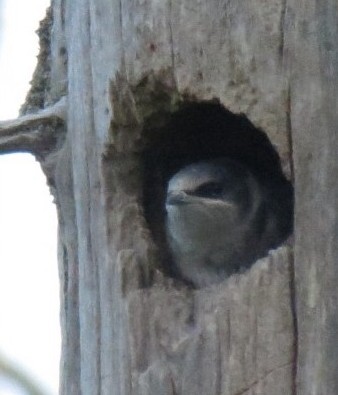
So far 15 freshwater nest box sites have been established in the Lower Mainland and lower Fraser Valley and 10 have been initiated on the east coast of Vancouver Island and the Gulf Islands, some on pilings and others on flooded snags (at left, Crofton Lake). Three of these sites were first occupied by Western Purple Martins in 2013, at Westwood Lake in Nanaimo and Comox Lake near Courtenay on east Vancouver Island, and at Burnaby lake in Vancouver on the BC Lower Mainland, and others have been occupied since. At several locations martins are nesting in cavities in old abandoned pilings left from earlier industrial activity, and they have begun using snag cavities in at least one location (Crofton Lake, right). We hope and expect to see this trend continue in future, with potential use of cavities in snags on upland sites when suitable habitat can be provided. There are currently ~120 active colonies established - most active colony locations are shown in the following map (2018):
B.C. Purple Martin Recovery Program Sponsor Spotlights Gold ($20,000 & over)
Silver ($10,000 – 19,999)
Bronze ($5,000 – 9,999)
For more information, see our Recent Publications below, visit our Purple Martin Links, or find out about our Adopt-a-Purple-Martin Program Recent Publications NEW 2013! - Status Report on the Western Purple Martin in BC, with previously unpublished results of biological research and population monitoring Cousens, N. B. F., and J. C. Lee. 2012. Status Report on the Western Purple Martin (Progne subis arboricola) in British Columbia. Prepared for the British Columbia Ministry of Environment, Victoria, BC. 117 pp. (Electronic resource). Western Purple Martin genetic relationships - comparison of eastern and western populations using mitochondrial DNA analysis Baker, A. J., A. D. Greenslade, L. M. Darling and J. C. Finlay. 2008. High genetic diversity in the Blue-listed British Columbia population of the Purple Martin maintained by multiple sources of immigrants. Conservation Genetics, Vol. 9, Num. 3, June 2008. Puget Sound Georgia Basin Research Conference, March 2007 - Knowledge for the Salish Sea: Toward Collaborative Transboundary Solutions B. Cousens et al. 2007. A Simple Population Forecast Model for Purple Martins in British Columbia. (Oral presentation) J. C. Lee et al. 2007. Update on Purple Martin Stewardship and Recovery in British Columbia, 2006. (Poster)
B. Cousens and F. Schrock. 2007.
Searching for Barn Swallow Fall Premigratory Roosts with Doppler Weather Radar
in western North America. (Poster) Puget Sound Georgia Basin Research Conference, March 2005 - Science for the Salish Sea: A Sense of Place, a Sense of Change B. Cousens et al. 2005.
Recovery of the Western Purple Martin bordering the 'Salish Sea' - the Georgia Basin of British Columbia and Puget Sound, Washington. (Science
conference paper)
B. Cousens et al. 2005.
Two Decades of Purple Martin Stewardship and Recovery in British Columbia - Successes and Challenges. (Poster)
BirdWatch Canada 2005 B. Cousens. 2005. A Purple Martin Success Story. BirdWatch Canada (Bird Studies Canada), No. 30, pp. 21-22. BC Species At Risk Conference, March 2004: Pathways to Recovery L. M. Darling et al. 2004.
Recovery of the Purple Martin in British Columbia: More Than a Nest Box Program. (Oral presentation)
Western Purple Martin Working Group (WPMWG) Publications The WPMWG has served since 1998 as an international coordinating body for researchers, government agency management personnel, non-profit groups, bird banders and volunteers working toward the study, conservation and recovery of the western subspecies populations of Purple Martin breeding west of the Rocky Mountains in Canada and the USA. Members of the group meet annually (usually at Vancouver, Washington) to share research and monitoring results, plan further studies and coordinate leg banding, conservation and recovery efforts. Secretary: Stan Kostka WPMWG - Interim Western Purple Martin Population Objectives Title: Interim Population Objectives for the Pacific Population of the Western Purple Martin - Western Purple Martin Working Group, 2005 (written in conjunction with Partners In Flight). WPMWG – Western Purple Martin Nest Site Use Assessment Protocols Title: Western Purple Martin Nest Site Type Identification and Site Use Classification Protocol Title: Western Purple Martin Colony Population Size and Reproductive Success Evaluation Protocol These are preliminary general protocols developed by the WPMWG to provide consistent and reliable methods of assessment of western Purple Martin nest site use, nesting success and productivity at inaccessible cavities. They are provided as working documents for application, evaluation and modification to specific cavity nesting situations as needed. If you apply either of these protocols and find them useful, discover a need for modifications or additions, or require further information, please contact us and let us know, so we can track usage and provide updates and other Purple Martin monitoring and recovery workers may benefit from your experience.”
|
|
Original web site design by Carley Colclough. Send mail to
GBEARS with questions or comments about
this site.
|










 good weather conditions throughout the breeding season
in these years, resulting in an ample food supply of flying insects for
both adults and nestlings. As for other swallows, the nesting success and
fledgling production of Purple Martins is highly sensitive to adverse (wet) weather-induced
reduction in food supply availability, and yearling (subadult) recruitment and
population growth or decline are highly dependent on reproductive success. An article about the history of the recovery of Purple Martins in BC, up to and including 2004,
was printed in BirdWatch Canada (winter 2005 No. 30, p.21-22), a publication of Bird Studies Canada, and is available
good weather conditions throughout the breeding season
in these years, resulting in an ample food supply of flying insects for
both adults and nestlings. As for other swallows, the nesting success and
fledgling production of Purple Martins is highly sensitive to adverse (wet) weather-induced
reduction in food supply availability, and yearling (subadult) recruitment and
population growth or decline are highly dependent on reproductive success. An article about the history of the recovery of Purple Martins in BC, up to and including 2004,
was printed in BirdWatch Canada (winter 2005 No. 30, p.21-22), a publication of Bird Studies Canada, and is available
 with
numbered bands which allow us to track their migratory routes, dispersal and
recruitment and colony and nest box selection throughout their lives, without
further capture or disturbance. Bands
read with spotting scopes in later years indicate that martins fledged from any
one colony return to nest at many different colonies throughout the Strait of
Georgia and Puget Sound, providing extensive genetic mixing within at least the
BC and Puget Sound, WA, population, with occasional dispersal to the lower
Columbia River Basin and
possibly to Oregon and California.
with
numbered bands which allow us to track their migratory routes, dispersal and
recruitment and colony and nest box selection throughout their lives, without
further capture or disturbance. Bands
read with spotting scopes in later years indicate that martins fledged from any
one colony return to nest at many different colonies throughout the Strait of
Georgia and Puget Sound, providing extensive genetic mixing within at least the
BC and Puget Sound, WA, population, with occasional dispersal to the lower
Columbia River Basin and
possibly to Oregon and California.

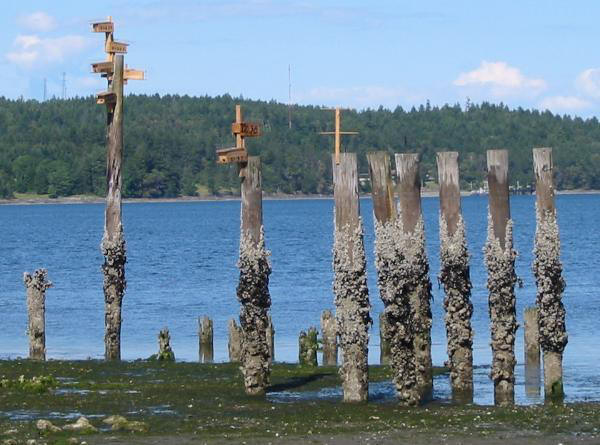 As
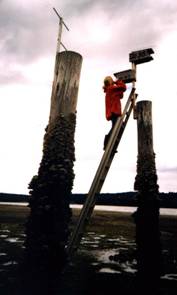
of 2018, most occupied Western Purple Martin colonies in BC were still located on pilings
along the marine coastal foreshore in bays, estuaries, and marinas, in or beyond the intertidal zone within the Georgia Basin. They are also at least 50-100m away
from trees and other tall structures on the foreshore that might provide hunting
perches and approach cover for ambush predators, mainly small hawks and falcons.
As
of 2018, most occupied Western Purple Martin colonies in BC were still located on pilings
along the marine coastal foreshore in bays, estuaries, and marinas, in or beyond the intertidal zone within the Georgia Basin. They are also at least 50-100m away
from trees and other tall structures on the foreshore that might provide hunting
perches and approach cover for ambush predators, mainly small hawks and falcons.